INTERNATIONAL KUNEKUNE PORK PROCEDURES
An IKHR Sanctioned program for Kunekune Hog Preservation Through Utilization.
Formally the International Kunekune Pig Pork Project, International Kunekune Pork Producers has taken the lead in promoting the Kunekune Hog for its incredible ability to graze grass cleanly and thrive in various production environments all while turning it into beautifully succulent, red, well-marbled and delicious tasting pork. This, along with copious amounts of excellent, pure white fat and beautifully unblemished leaf lard.
THE STORY
The AKPR/IKHR was the first organization to promote the breed as a meat animal in the USA securing its status around the world as pig perfect for large or small farms, urban/city farms, homesteaders, pastured pork production, charcuterie aritsans, home butchery, farm to table eateries, and the list goes on.
A growing number of Kunekune Hog breeders and farmers in countries around the world are recognizing the added value the breed can bring to their many varied operations. These dedicated breeders wish to honor the legacy set forth by the Maori people of New Zealand and have taken on the responsibility to preserve the breed through its utilization as a meat animal.
The IKHR seeks to access the hard data that these unparalleled breeding programs can provide to the historic record of the Kunekune Hog breed all across the globe. All breeders of purebred, registered Kunekune Hogs are invited to become one of the valued members of the Project and to join us in providing this much needed data with the goal of a secure future for the Kunekune Hog breed. *The data that is collected and recorded by the Project will be provided to its members and calculations for selection of breeding pairs to optimize production in their operations will be supplied by the Canadian Centre for Swine Improvement.
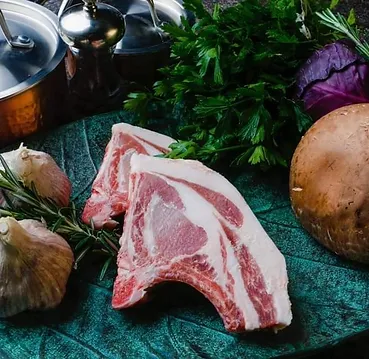
LOIN CHOPS
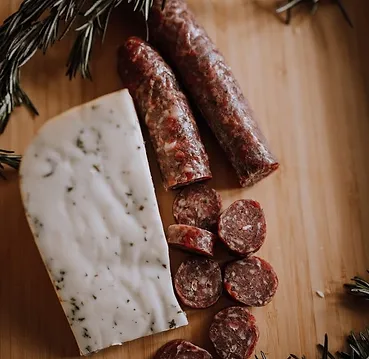
TUSCAN SALUMI
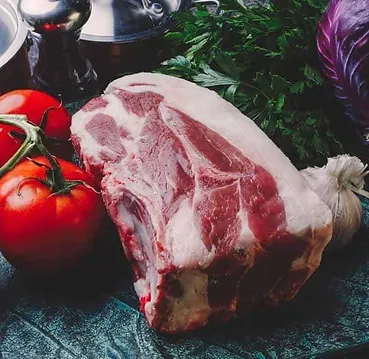
SHOULDER ROAST
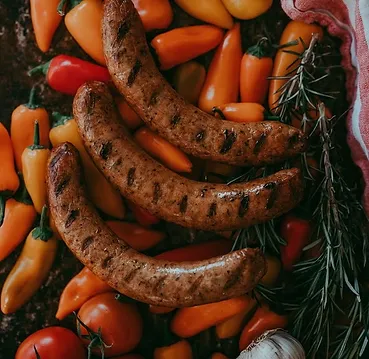
MILD ITALIAN SAUSAGE
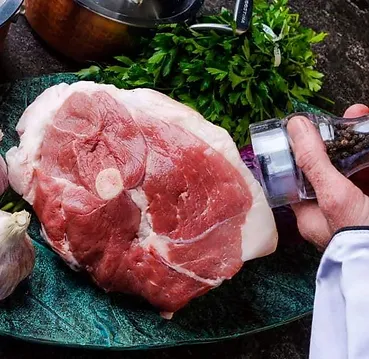
SHOULDER ROAST
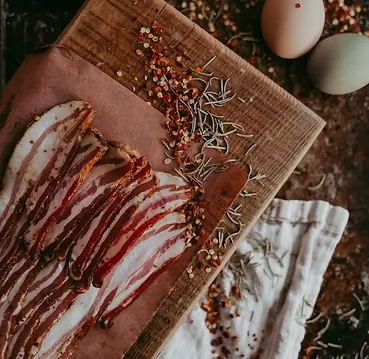
CHILI ROSEMARY BACON
KUNEKUNE PEDIGREE PORK
Ready to take Kunekune Pork Production to the next level??

Make your herd stand out by producing and marketing Certified Purebred Kunekune Pork!
The IKHR is pleased to offer this registration option for IKHR registered breeders – KUNEKUNE PEDIGREE PORK!! This initiative enables breeders to register Meat Animals produced within their breeding program for the purpose of verifying a purebred animal for the production of purebred meat product. The registration process is the same as that for registered breeding stock minus the need to DNA test these animals. While DNA testing is not required for meat animals, the IKHR reserves the right to randomly test animals or meat products as a means of audit. Similar to breeding stock, breeders may register meat animals to themselves or buyers of said animals. The registration application for Kunekune Pedigree Pork can be found here!
STANDARD OF PERFECTION
Updating of the Standard of Perfection for the Kunekune Hog breed is intended to provide a clear description of Kunekune characteristics for pasture, pork, and progeny.
When Kunekune Hogs are judged in the show ring, these characteristics and how well each hog displays them shall be the basis for awarded points and placement. Consideration of the head is of paramount importance when evaluating the breed. Head type identifies the breed as a grazer not prone to root and is considered unique to the breed.
As a matter of progress and improvement, all hogs to be officially registered with IKHR must possess two wattles at the time of birth. Photographic proof will be required. Any non-wattled hog that has already been officially registered prior to January 1, 2021 will continue to be recognized as such. Any hog born after July 1, 2020 must be proved to have two wattles at the time of birth as a requirement for registration. No non-wattled hogs will be accepted into the foundation herd book with official registration after January 1, 2021 regardless of their date of birth. Non-wattled hogs will still be included with the breeder’s Litter Notifications as a matter of record and research.
In summary, animals born after July 1, 2020 must have two obvious wattles with photographic proof for official registration.
Qualified Registrations will be denied for any non-wattled animal and their offspring. When applying for qualified registration of wattled offspring please ensure that all ancestors not yet listed in the IKHR herd book have 2 wattles and are eligible for entry. Any non wattled ancestor along the genetic chain that is not already listed in the IKHR herd book will be denied entry creating a break in ancestry and inhibiting the entry of prodigy from that point onward.
General Appearance:
Form: Relatively long, level, and deep. Boars generally weighing up to 400 pounds and sows generally up to 350 pounds, the result of a thick cover of firm flesh and fat.
Quality: Uniform covering of hair, clean skin, medium/heavy bone, even covering of flesh and fat.
Condition: Overall appearance shall be one of balance. Deep uniform covering of flesh and fat especially in regions of valuable cuts.
Characteristics:
Head: Proportionate to body, evenly set on shoulders. Broad. Wide forehead. Short, broad, upturned snout with large, symmetrical nostrils to facilitate respiratory ease and teeth suitable for grazing. Teeth shall be set back inside the mouth and must not protrude when mouth is closed. Medium to heavy jowl, not wasty. Sweeping jawline.
Objections: Head not proportionate to body size, set unevenly. Narrow forehead - animals with wider foreheads are generally symmetrical and wider in the chest and back. Longer, shallower heads generally correlate with a similar body type resulting in less meat mass. Long, straight snout, uneven nostrils, teeth whose angle is unsuitable for grazing, protruding teeth or teeth set forward, droopy bottom lip. Wasty jowl (excessively fat), or thin, trim.
Eyes: Set well apart and symmetrical, bright, intelligent and kind.
Objections: Eyes set narrow or at unequal levels. Dull.
Ears: Set wide apart on the top corners of the head. Symmetrical in form and attachment. Pricked to semi-lopped, inclined forward. Under control of the hog. Settling firmly out over the eyes when grazing - ears should have the appearance of a visor over the eye, coming firmly from the head and out.
Objections: Ears set narrow or not of the same size, set or shape. Ears that roll up or are laterally folded along their length shall be avoided. Ears set on the side of the head, point outward to the side, not inclined forward, lopped. Ears may curb vision but should not obscure forward view. Emphasis to avoid ears that are laterally folded along their length as though “folded in half”. Purpose of ears include hearing, but also protection of the eyes from sun.
Wattles: Two, well-formed and well-attached in the same location on the corner of the jowl on each side hanging freely. Firm and of kidney or thumb shape. Symmetrical in size and shape. Two wattles present is required for entry to the show ring in any AKPR Sanctioned show (implemented August 1, 2019).
Objections: Less than two wattles, poorly attached, uneven size or shape, unevenly set on jowl. Wattles set high causing wattles to flare out.
Neck: Short to medium, proportionately and evenly set on shoulders. Deep and thick.
Objections: Long, uneven, thin, shallow.
Shoulders: Level and in proportion to hams, broad, deep, full. Sloping and aligned with legs and sides. Well developed. Muscle extending well down legs. Should not protrude above the line of the back.
Objections: Shoulders not uniform with hams, thin, shallow, weak, protruding above level of back.
Chest: Moderately wide between the legs. Deep girth.
Objections: Narrow, shallow, thin. Front legs set too narrow or too wide for chest width.
Back & Loin: Strong, level or slightly arched when grazing. Medium to long length and level to root of tail. Width even from shoulder to ham/rump when viewing from above. Even and smooth, firm not pliable. Rounded at croup, base of tail not flat.
Objections: Narrow, swayed or highly arched back, weak or mushy. Heritage hogs’ width typically averages the same from shoulder to ham/rump. Pliable feel to back could mean that the hog retains too much fat. Length should not be excessive as this can affect breeding and the productive life of hog due to weakness. Flat croup (area in front of the tail).
Sides & Ribs: Deep. Well-sprung ribs in proportion with shoulders and hams. Symmetrical from front to back.
Objections: Narrow, thin, shallow, pinched. *Long, deep bodied animals indicate a good capacity for organs and carry a larger quantity of high quality loin cuts.
Belly & Flank: Thick, flat, even underline. Flank smooth and full, in line with the sides, well let down.
Objections: Flabby, loose, droopy underline. Underline pulled up or thin. Flank out of line with sides.
Teats: At least 10 sound, evenly spaced, well-paired teats starting well forward.
Objections: Blind or inverted teats in gilts, sows, or boars. *Animals with 12 or more teats are desirable.
Hams & Rump: Hams broad and deep with good width coming well down to the hock. Rump slightly rounded from loin to base of tail.
Objections: Narrow, thin, long hams not extending well down to hock. Rump narrow, too flat, or dropping off too sharply. Flat croup.
Tail: Curled or crooked expressing movement. Set high. Attached as the hip falls from the back. With no depression at root. Moderately long but not coarse, well tasseled.
Objections: Straight, short, lack of tassel. *Tail set too low indicates steep rump which can lead to various joint, breeding and birthing issues due to stress on joints, restricted motion, and mal-alignment.
Legs: Short to medium, straight, strong boned, well tapered and well set apart. Pasterns springy, providing adequate cushion, consistent with heritage breeds.
Objections: Extremely long, short or thin legs. Knock knees, bucked knees, or pigeon toed. Post legged or stiffness - lack of proper shock absorption during locomotion. Legs set too narrow. Legs should be solid, thick and strong, placed squarely on all four corners of the body to provide adequate balance and proper support for the weight of the hog*. Rear legs should not appear to be standing on tiptoes nor be rocked back onto pasterns. Dew claws off of the ground when on firm footing. Weak foreleg pasterns are tolerable in heritage hogs but weak knees must be avoided due to premature breakdown of animals with the anatomical deformity. *Back legs set under the animal is common and true to heritage breeds, therefore, should not be considered a fault.
Feet: Strong with even, short to medium cleys consistent with heritage breeds.
Objections: Overly splayed. Excessively flat footed. Cleys of unequal size, twisted, or overly long. *Commercial breeds have been bred to stand upright on small, closed toes to improve the appearance of the hams without consideration of comfort for ease of movement on pasture. Heritage breeds often display soft, flexible pasterns with open toes appropriate for their age and weight. Open toes and flexible pasterns are true to heritage breeds and should not be viewed as a fault.
Skin & Hair: Clean coat of fine quality, any color, texture, or pattern.
Objections: Hair not covering the body evenly. Swirls, cowlicks, hair growing in different directions on the body. Dullness. Lumps, bumps, or roughness of skin.
Testicles: Easily seen with each of the same size and carriage.
Objections: Uneven size or carriage, not easily seen. Flabby low scrotum.
Temperament: Placid in nature, active and alert, confident, docile, inquisitive. Easily handled and driven.
Objections: Wild, aggressive, difficult to control or drive. Dull.
Action: Free, firm, fluid and forward in motion. Alert.
Objections: Limping, lameness, stiffness, weak, wobbling. Dull.
Sexual Characteristics:
MALE ~ boars should be strong in traits peculiar to the sex. Head may be slightly coarse, the neck full and arched somewhat, with the shoulder heavy. The forequarters are usually slightly heavier than the hind quarters and this distinction grows more evident with age as shields develop. Strength of frame without coarseness is desirable. Body should be deep, long, and low. Strong, short/medium legs with straight pasterns. At least 10 sound, evenly spaced, well-paired teats starting well forward.
FEMALE ~ after breed type, sex type is of first and foremost importance in sows. She shall have no signs of coarseness instead being feminine in overall appearance, neat, and sharp. The width before and behind should be almost uniform. Length of body abundant for growing litters and easy farrowing. She shall possess at least 10 sound, evenly spaced, well-paired teats starting well forward, none blind.
ABOUT THE BREED
The Kunekune Hog (pronounced "cooney cooney") is a breed known as the "Maori Pig" having been developed by the first people of New Zealand. Being near extinction in their homeland during the 1970's, two animal preservationists, Michael Willis and John Simister, are credited with their conservation. Since that time, the breed has gained recognition on both the North and South Islands of New Zealand, in Great Britain and Europe, the United States and, most recently, in Canada. The Kunekune Hog is finding a serious niche market for small farms, in sustainable farming systems, for permaculture, and with chefs, charcuterie artisans, caterers, and in home butchery.
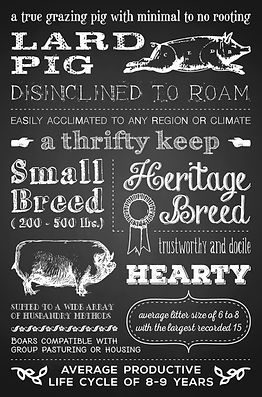
UNIQUE CHARACTERISTICS - Kunekune Hogs are a smaller size hog with boars reaching up to 500 pounds and sows 400 pounds. They are varied in hair color and hair texture with ears that are pricked or semi-lop. Extremely docile in temperament, the breed is suitable for first time hog growers. For a comprehensive description of physical characteristics, see BREED STANDARD.
FEEDING - Kunekune are known to many as "the Grazing Hog" being extremely efficient on grass and not prone to root or roam. Pasture grasses work well with supplementation to satisfy dietary needs for appropriate protein intake as well as vitamins and minerals. Hay can be fed when pasture is scarce or unavailable. Commercial hog feeds, organic or proprietary feeds, along with garden excess all work to guarantee your hog's optimum condition. Gestating and lactating sows as well as piglets should always get a daily ration in addition to any pasture and/or hay. When feeding out meat hogs for sale or for your family's table, consider the reason behind the niche market for those who practice excellent husbandry. The "alternative system" of rearing your hogs out-of-doors in an open-air piggery and feeding them from the orchard and garden not only speaks to buyers, but produces exceptional quality and taste in the pork that you produce.
HOUSING - Hogs need housing and shade in order to thrive in any environment. Depending upon the climate and conditions, producers will need to provide a relatively draft free space with clean bedding and protection from sun, wind and rain. In the coldest climates, deep straw or hay, perhaps with a layer of wood shavings underneath, will be required to keep hogs warm and dry.
REGISTRATION OF CLONED KUNEKUNE HOGS
Somatic Cell Nuclear Transfer (SCNT)
A cell-cloned animal is one that results from cells produced through a tissue sample provided by a genetic cell-donor, they are combined with an enucleated oocyte (unfertile egg with the nucleus removed) and fused together using a process called electrofusion. The resulting embryos are cultured and transferred into recipient mothers.
The following requirements shall apply to the registration of hogs resulting from Somatic Cell Nuclear Transfer (SCNT):
The individual applying for registration must be a registered breeder in good standing with the International Kunekune Hog Registry (IKHR).
Only SCNT cell-cloned animals shall be eligible for registration. Genetically altered or genetically modified animals shall never be considered for registration. The sire and dam on the registration certificate of the cell-cloned animal will be the same as the cell-donor animal.
The cell-donor animal must be DNA tested for proof of parentage and registered in the IKHR herd book.
The cell-donor animal and the cell-cloned animal must be DNA marker typed for a genetic match. This will be the standard parent verification that is required for genetic confirmation and registration of a cell-cloned animal.
The owner of the cell-donor animal at the time of tissue harvest will be identified as the breeder of the cell-cloned offspring.
Hogs conceived after the death of cell-donor animals, shall be eligible for registration under the same conditions and provisions governing the eligibility of hogs conceived prior to the death of said animal.
Registration of cell-cloned animals shall be made on the standard registration form and the appropriate section marked designating the animal as a cell-cloned Kunekune Hog.
Registration certificates issued for cell cloned animals shall indicate that the animal is a Cell-Cloned Kunekune Hog. The registration number of the cell-donor animal, which was cloned, shall also be stated on the registration certificate. The name of the cell-cloned animal shall have the same name as the cell-donor and the symbol “SCNTxx” will be added to the end of the name, where “xx” is the sequence number of the cloned animal. An example is ABC Mahia Love 1 SCNT01, which would be the first cloned hog of ABC Mahia Love 1.
DISCLAIMER
The International Kunekune Hog Registry (IKHR) has taken care in preparing the information contained in this web site but cannot guarantee its accuracy. Moreover, we cannot guarantee the accuracy of information contained in the various linked sites as the owners of those sites, alone, are responsible for verifying the accuracy of their information. The IKHR shall not under any circumstances be liable to any person for any special, incidental or consequential damages, including, without limitation, damages resulting from use of or reliance on the information presented, loss of profits or revenues or costs of replacement goods, even if informed in advance of the possibility of such losses.
The IKHR is not affiliated with and does not license or endorse any breeders, including those listed on this site. The breeders listed here are in good standing with the registry having paid the annual fee as well as satisfying the requirements for hog registrations and have authorized the release of their names to individuals inquiring about the breed. Contacting these breeders should be done directly by telephone, e-mail, or mail. The IKHR encourages buyers to investigate the persons they contact carefully to be certain that their standards of quality and ethics meet buyer’s expectations. Every potential buyer should thoroughly investigate breeders and their stock before committing to a purchase. IKHR strongly recommends that transactions with breeders be undertaken with the same caution and due diligence as one would devote to any important business matter.
The IKHR in no way guarantees the services of any of the listed breeders. The IKHR has no control over their business practices and is not liable for any dealings between a buyer and any breeder(s). It is the buyer’s responsibility to make sure they are given a contract stating they will receive IKHR papers, health guarantee and containing pertinent specifics regarding the sale from the seller before purchase. The IKHR accepts no responsibility for any transaction whether written, verbal, or implied between seller and buyer; or any dispute resulting thereafter. The IKHR does not assume any responsibility or liability regarding any agreements one may enter into with any breeder; nor for the warranty, guarantee, integrity, honesty, reliability, expressed or implied, by any IKHR breeder included on this list. The IKHR will not be involved in any manner in disputes between Kunekune buyers and breeders.
These listings are provided as a service to IKHR Breeders and the public. The selection of a breeder is an important one. We encourage any prospective Kunekune owner to become familiar with our Breed and Breed Standard prior to contacting any breeder.
WE RESERVE THE RIGHT TO REFUSE SERVICE TO ANYONE
NEOGEN DNA TESTING REQUEST FORM
Click the link below to open the Sample Submission Form, type your information directly on the form, save as an Excel file and email to Neogen at: NeogenCanada@neogen.com
Please ensure you include "IKHR" in your email subject line!
DNA Testing Request Form - Parentage Verification, Pork & Prodigy Panel, F4 Resistance
Order DNA Test Supplies from Neogen
BREEDER TUTORIAL
Ordering DNA testing online via UC Davis ~ USA and Canada ONLY
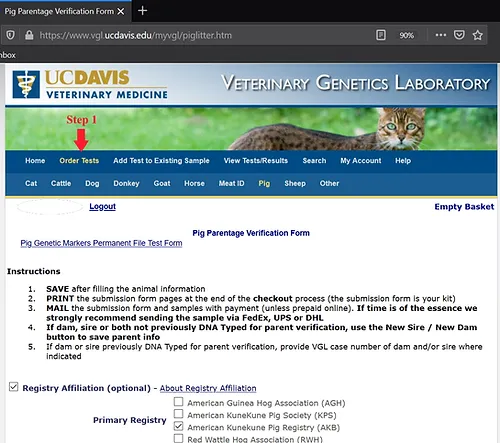
Please visit UC Davis/VGL Login. If you have not established an account with UC Davis you will need to do this first. Login to your account and click "Order Tests" (Step 1) to begin.
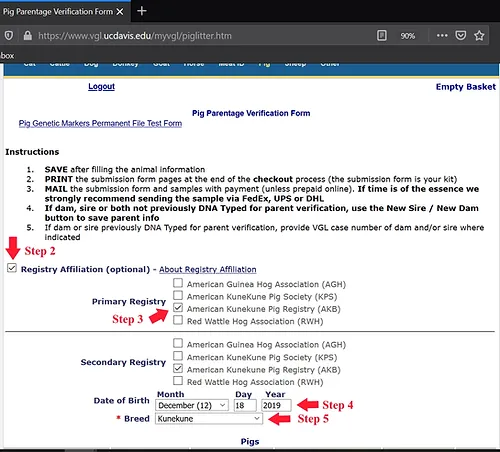
Step 2 - Check box beside "Registry Affiliation"
Step 3 - Check box beside "American Kunekune Pig Registry (AKB)" as your Primary Registry in order to receive the DNA discounted rate of $31.00 per test
Step 4 - Enter the date of birth for your litter
Step 5 - Select "Kunekune" for the breed
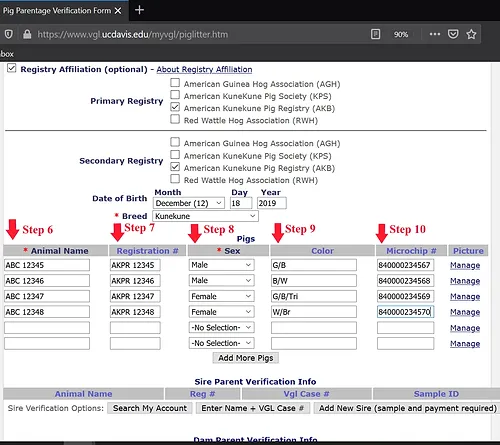
Step 6 - Enter the name of the first pig in the litter that you wish to test. **Please reference your IKHR Litter Notification for this step** NOTE: If you do not have assigned herd book numbers, stop here and submit a litter notification to the IKHR in order to obtain these numbers FIRST. Please follow IKHR protocol for the purpose of naming of pigs for DNA testing -- use a combination of your herd prefix plus the numeric portion of your herd book number for the particular animal you wish to test. For example, if your herd prefix is "ABC" and the herd book number for the pig you wish to test is "IKHR 12345", then the temporary name of the pig for testing purposes should be "ABC 12345". Please note: IKHR will assign the official Bloodline Name and update the VGL DNA record with this information once DNA testing is complete and parentage has been confirmed, "ABC 12345" will not be the animal's permanent name.
Step 7 - Enter the IKHR herd book number. Using the example listed above, this would be "IKHR 12345"
Step 8 - Enter the sex of the pig
Step 9 - Enter the color of the pig
Step 10 - Enter the ID number for the pig. Please note this field asks for microchip number but you can also enter the Tattoo Number, Ear Tag Number or Ear Notch Number depending on the form of identification that you are using.
Complete steps 6 - 10 for each additional pig from this litter that you wish to test.
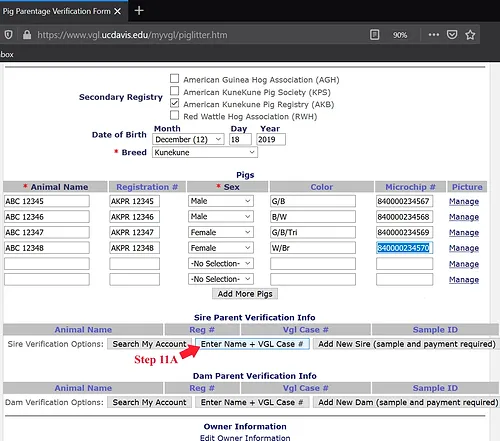
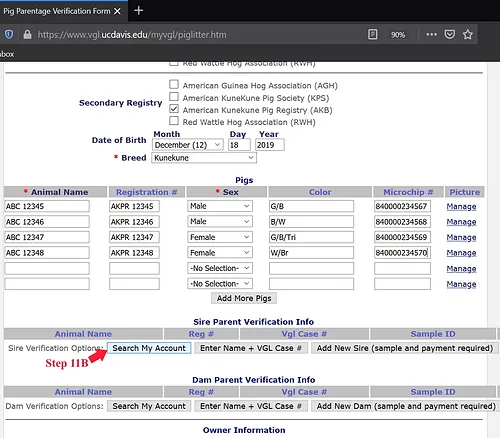
Step 11A - Selecting sire and dam to test against. If the sire and/or dam of your litter were produced and tested by another breeding program click "Enter Name + VGL Case #" which will require to you know specific information regarding the sire and dam.
Step 11B - Selecting sire and dam to test against. If the sire and/or dam of your litter were produced and tested by yourself click "Search My Account" which will display a list of animals you have DNA tested and allow you to select the correct animal from a drop down list.
Step 12 - If you choose Step 11A - enter the official name of the sire in the "Animal Name" field
Step 13 - If you choose Step 11A - enter the official herd book number of the sire in the "Reg #" field
Step 14 - If you choose Step 11A - enter the VGL case number in the "Vgl Case #" field
**Repeat steps 12 - 14 for dam
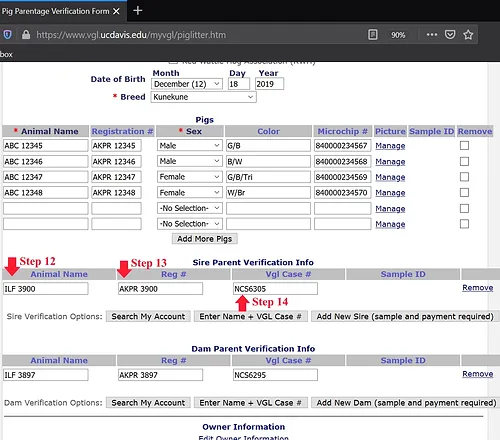
Repeat steps 12 - 14 for dam
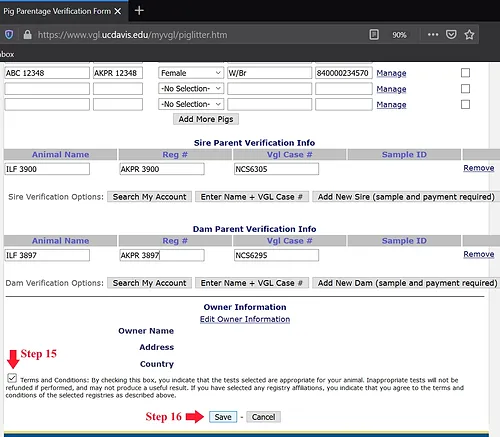
Step 15 - Click the check box to accept "Terms & Conditions"
Step 16 - Save your order
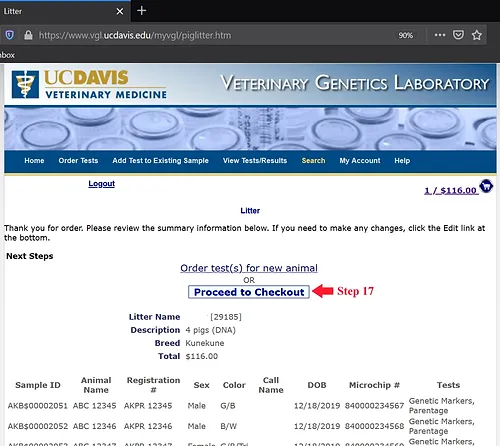
Step 17 - You will now be taken to a screen which allows you to pay for your tests and complete your order, click "Proceed to Checkout"
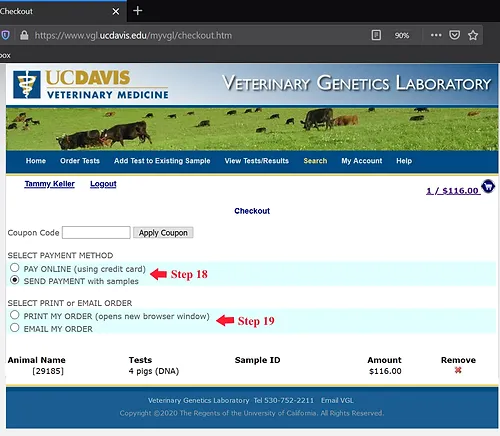
Step 18 - Choose your preferred method of payment
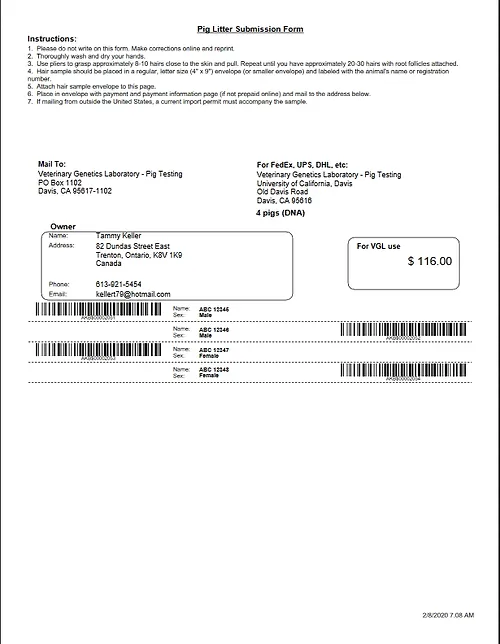
Step 19 - Choose to either email or print your order, please note you will also be able to access your order from your UC Davis account. This step will generate the paperwork which you must print and mail with your hair samples.
Step 20 - If you choose to pay online, please click "Pay Basket" to complete the payment
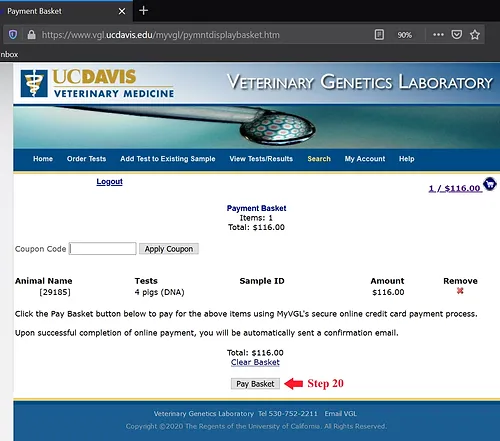
Step 20 - If you choose to pay online, please click "Pay Basket" to complete the payment
SNP TESTING VS. MICROSATALITE TESTING
DNA is present in every living thing. It is the code that makes each of us unique albeit very similar. This code is made up of repeating units called “base pairs” and there are 4 possible “base pairs” which are known by the first letter of their name: A, T, G, and C. The sequence of A, T, G, and C gives every individual their unique genetic code, and except for identical twins, no two people have the exact same sequence of A, T, G, and C’s. This unique genetic code is passed on to offspring so that each offspring receives half its DNA from its father and the other half from its mother; creating a unique combination that is very similar to the parents. Knowing that every offspring is a combination of its parents’ DNA has allowed scientists to develop tests to determine which individuals are the parents of a given offspring.
There are several different technologies that can be used for DNA Testing. In livestock, two of the more common technologies used are Microsatellite Testing and SNP Testing (Single Nucleotide Polymorphism, pronounced “snip”). These two technologies are incredibly different. So different, in fact, that we cannot compare the results between them. Microsatellite Testing is based on counting the number of small repeating segments in an animal’s DNA. SNP Testing looks at the content of the DNA or what the actual A, T, G, or C is at a specific location in the genetic code.
 Figure 1: Example of a Microsatellite. The microsatellite score is determined by counting the number of “base pairs” in each repeating section. This animal has a score of 16/20 because it received DNA from its father with 5 repeating blocks and 4 “base pairs” per block (5 x 4 = 20) and it received DNA from its mother with 4 repeating blocks and 4 “base pairs” per block (4 x 4 = 16). There is a 50% chance that this animal will pass the 20 to its offspring and a 50% chance that it will pass the 16 to its offspring. This animal cannot pass both the 16 and the 20 to its offspring.
 Figure 2: Example of two SNPs. The SNP result is determined by determining which “base pair” is present at a specific location in the DNA. This animal would be reported as a G/T at the green SNP location and would be reported as a C/A at the blue SNP location. This animal received the G (green) and C (blue) from its father and received the T (green) and A (blue) from its mother. There is a 50% chance that this animal will pass the G (green) and C (blue) to its offspring and a 50% chance that it will pass the T (green) and A (blue) to its offspring. This animal cannot pass both the G and T (green) or both the C and A (blue) to its offspring.
One of the key differences between Microsatellites and SNPs is how many of them exist in an individual’s DNA. Microsatellites are relatively rare but in mammals, there is approximately 1 SNP for every 1000 “base pairs”. Just to note, mammals have approximately 3 billion “base pairs”. What this means, especially for parentage testing, is that there are many more locations in the DNA to use for comparing offspring with their potential parents. In practice, parentage testing with microsatellites utilizes between 12 and 40 locations in the genome, depending on the species. Using SNPs in parentage testing uses many more locations. For swine, Neogen starts with 96 SNPs spread across the pig’s DNA. If more than one boar or more than one sow matches to a piglet, then we will move to using 1000 SNPs. If 1000 SNPs cannot resolve ambiguous parentage matches, then we move to using 50,000 SNPs. Many other livestock species have switched to SNP parentage for the improved resolution it provides when related breeding animals are in the same mating group.
Further advantages of using SNP technology for DNA testing is that it has applications beyond parentage testing. Many other livestock species now use SNP testing for determining genetic condition status, physical trait status, and to improve the accuracy of traditional Expected Progeny Differences (EPDs) which provides more insight into how an animal’s offspring will perform for specific traits.
Looking to the future for the Kunekune breed, having a database of SNP genotypes that can laterbe paired with trait records by researchers could lead to the discovery of genetic markers for traits that are of interest to Kunekune breeders. By learning more about the genetics behind those interesting traits we can develop genetic tests to better predict how an animal will perform or what physical characteristics it will display.